
Ask any small business owner where leads come from and they can tell you. Ask where leads go and the answer gets vague. In our experience reviewing intake processes, the pattern is consistent: a request arrives, someone intends to reply, and the reply happens hours later — or never.
Speed is the whole game
A prospect who fills out a form is comparing options right now. The first business that responds with something specific and helpful sets the frame for everyone else. That does not require a sales team on call. It requires a reliable first response and a follow-up plan that does not depend on memory.
The 5-minute rule
Here is the rule we design around: every inquiry gets a specific, human-sounding reply within five minutes, during business hours or not. "Specific" matters more than "fast." A reply that mentions the service they asked about and asks one clarifying question beats a generic "thanks for reaching out" every time.
What a good first reply contains
- One sentence that shows you read the request.
- One or two clarifying questions that your team would ask anyway.
- A clear next step — and a way to opt out.
Follow-up without nagging
The second most common failure is follow-up. Either it does not happen, or it happens too aggressively. An automated schedule — day one, day three, day seven — that stops the moment the lead replies is both kinder and more effective than a person trying to remember.
Automation should make your team more human, not less. Let software handle the timing; let people handle the conversation.
What this looks like in practice
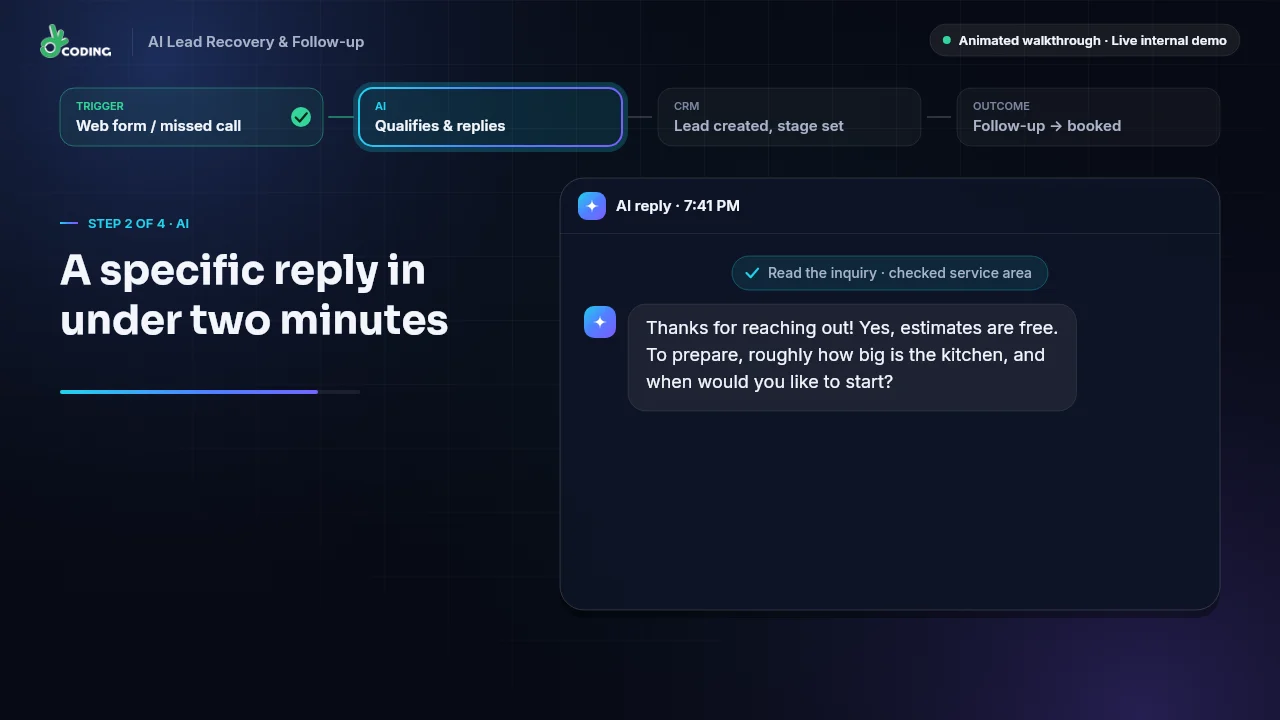
In our Lead Recovery demo, an inquiry arrives at 7:40 PM. The assistant replies in under two minutes, creates a lead in the CRM with a summary, and schedules a follow-up. When the homeowner answers the next morning, the sequence stops and a human picks up with full context.
Nothing here guarantees a result — your offer, your market and your follow-through still matter. But removing silence from the process is the cheapest improvement most businesses can make.
Why "we'll get back to you" fails
Slow replies are rarely about laziness. In most small businesses the same few causes come up again and again:
- Nobody owns the inbox. Form messages go to an email address that several people can see, so everyone assumes someone else replied.
- Requests arrive when no one is free. Evenings, weekends, or the middle of a busy shift.
- The reply needs information the team doesn't have yet, so it gets postponed until "later".
- Follow-up lives in someone's memory. When that person is busy or away, it stops.
None of these is fixed by asking people to try harder. They are fixed by a process that doesn't depend on someone being free.
How to measure your response time today
Before changing anything, find out where you are. It takes about twenty minutes:
- Take your last 20 inquiries from your website form, email and social messages.
- For each one, note when it arrived and when the first real reply went out.
- Count how many never got a second message after the first reply.
If most replies take hours, or many leads got only one message, you have found the cheapest place to improve. Our ten-minute website form check is a good companion test.
What makes the 5-minute rule realistic
Hiring someone to sit by the inbox is expensive. A few pieces of automation do most of the work:
- An instant confirmation that tells the customer what happens next.
- A CRM record for every inquiry, so nothing lives only in an inbox. See custom CRM development.
- An alert to the person on duty, by text or chat, not just email.
- A specific first reply drafted from what the customer actually asked.
- A follow-up schedule that stops as soon as the customer replies.
This is the system we describe on our never miss a lead page and build as part of AI automation for small businesses.
How this looks in different businesses
- For auto repair shops, most lost leads are missed phone calls, not forms. See how auto repair shops stop losing jobs to missed calls.
- For home-service companies, the crew is on a job when the request arrives. See the 5-minute reply for home-service companies.
Frequently asked questions
Is an automatic reply enough on its own?
No. A generic "thanks for reaching out" doesn't help much. The first reply should show you read the request and ask the one question your team would ask anyway. After that, a person should take over.
Won't automated follow-up annoy customers?
Not if it is short, relevant and stops the moment they answer. Three messages over a week, each with an easy way to opt out, is very different from daily reminders.
What about phone calls?
Calls need their own setup, such as a text-back when a call is missed or an AI receptionist. We compared the options in AI receptionist vs. answering service.
If you'd like to see where leads are slipping in your business, book a call with a specialist.
This article describes approaches and how our demos behave. It does not report measured customer outcomes unless it says so with methodology and permission.