
If your business misses calls, you have probably looked at two options: a human answering service, or one of the AI receptionists that appeared in the last couple of years. Both promise the same headline, "never miss a call." They are not the same product, and the right choice depends on what you need to happen after the phone is answered.
Here is the comparison we walk clients through, without the sales pitch for either side.
What an answering service does
A traditional answering service is a call center. Operators answer with your business name, follow a script you provide, take a message, and send it to you by email or text. Good ones can also book appointments if you give them access to a calendar, and transfer urgent calls.
Strengths
- A real person. For some callers, especially older customers and anyone in distress, that matters.
- Handles the unexpected reasonably well. If a caller goes off-script, a human improvises.
- No setup beyond writing the script.
Weaknesses
- The operator does not know your business. They are reading a script, often for dozens of companies. Questions outside it become "I'll have someone call you back."
- You pay per minute or per call, and the bill grows with exactly the calls you most want: the long ones.
- Quality varies by shift. The 2 a.m. operator is not the 10 a.m. operator.
- Messages, not outcomes. You get "John called about a leak" and the work of calling John back is still yours.
What an AI receptionist does
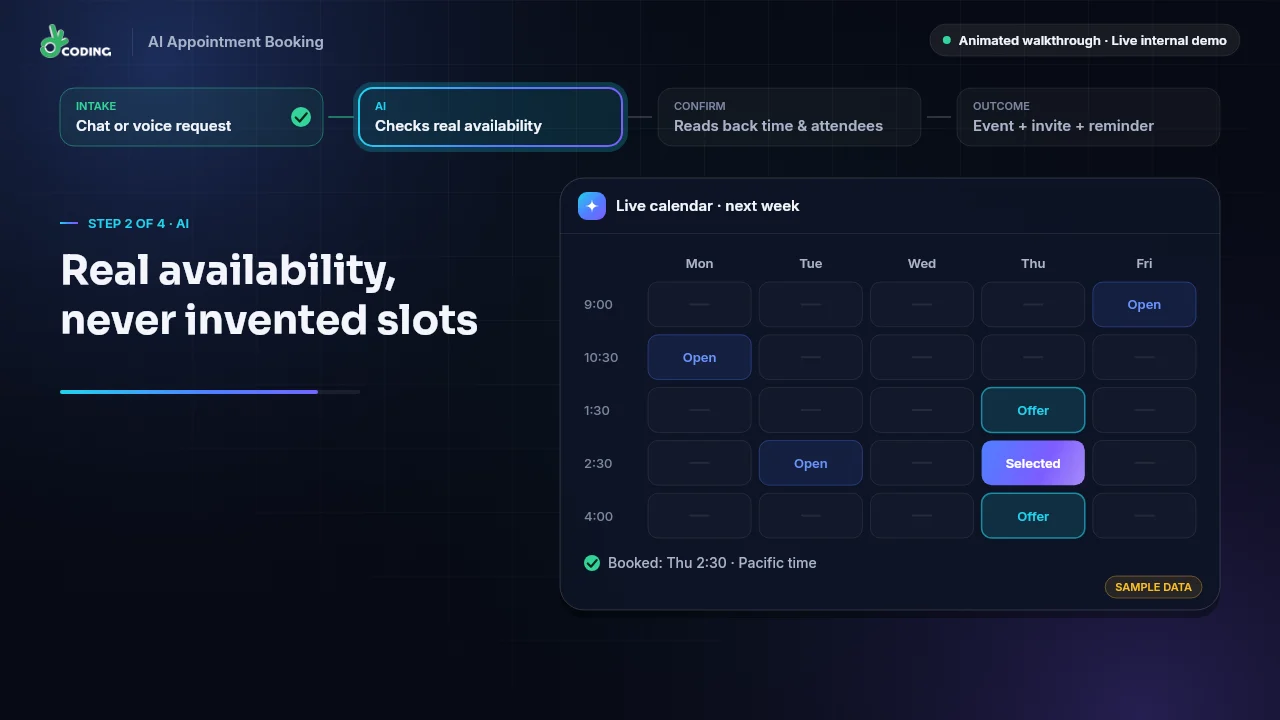
An AI receptionist is software that answers calls and messages, holds a conversation, and takes actions: books into your real calendar, answers questions from your own information, collects details, sends confirmations, and hands off to a person when the conversation needs one.
Strengths
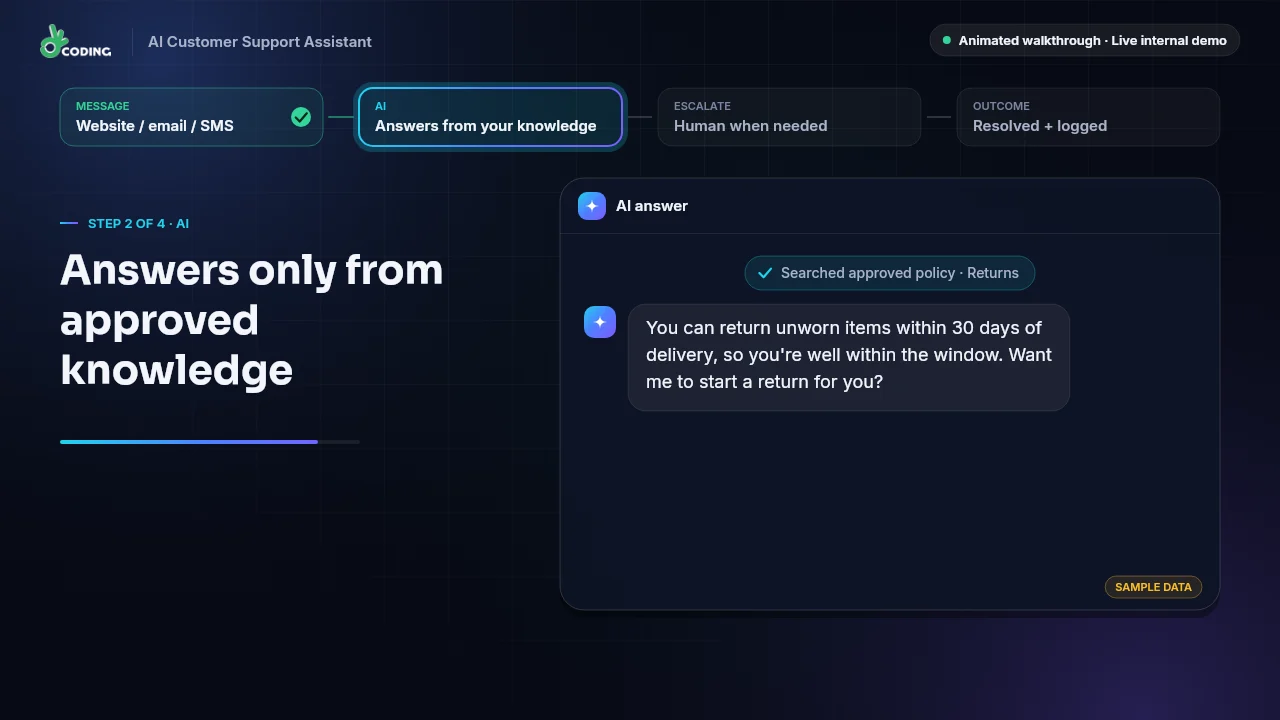
- It knows your business as well as you tell it. Hours, services, prices you choose to publish, policies, FAQ. It answers the same way at 2 a.m. and 2 p.m.
- It finishes the task. A booking is booked, a form is filled, a confirmation is sent. You get the outcome, not a note.
- It scales for free. Ten simultaneous calls on a Monday morning cost the same as one.
- Every conversation is logged word for word, which makes it easy to improve the script and to check what was promised.
Weaknesses
- It should never pretend to be human, and some callers will ask to speak to one. Good setups make that handoff instant; bad ones trap people.
- It is only as good as its setup. A generic AI receptionist with no knowledge of your business sounds like a generic AI receptionist.
- Edge cases need rules. Emergencies, angry customers and anything with legal or medical weight have to be routed to people, deliberately.
You can hear what a well-configured one sounds like in our customer support demo, including the moment it hands off to a person.
Side by side
| Answering service | AI receptionist | |
|---|---|---|
| Answers 24/7 | Yes | Yes |
| Knows your services and policies | Only what fits a one-page script | Everything you give it |
| Books real appointments | Sometimes, with calendar access | Yes, against live availability |
| Answers "how much" / "do you take" questions | Rarely | Yes, within the limits you set |
| Handles ten calls at once | No, callers wait | Yes |
| Cost model | Per minute or per call | Fixed, plus usage that is small per call |
| Consistency | Depends on the operator | Identical every time |
| Human when needed | Already human | Transfers or schedules a callback |
| Record of the conversation | Operator's summary | Full transcript |
When the answering service is the right call
- Your callers are mostly elderly or in stressful situations where a human voice is the product.
- Your call volume is tiny and irregular, so a per-call price is cheaper than any system.
- You have no digital calendar or CRM for an assistant to work with, and no plan to add one.
When the AI receptionist is the right call
- Missed calls are costing you booked work: repair shops, clinics, home-service companies, law offices.
- Callers ask the same twenty questions, and you want them answered correctly every time.
- You want the call to end with something done: a booking, a lead in your CRM, a confirmation sent.
- You already live in a calendar or CRM, so there is a system of record for the assistant to write into.
The hybrid most businesses end up with
In practice the strongest setup is not either/or. The assistant answers first, every time, handles the routine 70 to 80 percent of calls end to end, and routes the rest to a person: your own team during hours, a small answering service or on-call phone after hours. The human time you pay for goes to the conversations that need a human.
That is also why we do not sell a boxed "AI receptionist." Every setup starts with the question of what should happen with each kind of call, and the answer is different for a dental office and a plumbing company. If you want to think it through for your business, book a short call and a specialist will map it with you, including the cases where the honest answer is that you do not need this yet.
This article describes approaches and how our demos behave. It does not report measured customer outcomes unless it says so with methodology and permission.