
If you have decided to automate a few repetitive tasks, you will quickly run into two names: Zapier and n8n. Both connect the apps you already use, both let you build "when this happens, do that" workflows, and both now market AI features. They are built on different ideas, and that decides which one costs less and breaks less often. This guide compares them for a business owner, using each vendor's pricing page as of November 2026.
If you are still deciding what to automate at all, start with what to automate first in a small business. The tool matters less than picking the right process.
The short version
Zapier is a hosted service built for non-technical users. You sign in, pick a trigger app, pick an action app, and it runs. It has a very large library of ready-made app connections, and someone else handles servers, updates and uptime.
n8n is a workflow tool that you can use in n8n's cloud or install on your own server. It is more technical, gives you more control over logic and data, and can be much cheaper at high volume. In return, someone on your side has to be comfortable with things like JSON, API keys and, if you self-host, server maintenance.
How each one charges you
The two tools count usage differently, which changes the math.
Zapier counts tasks. According to Zapier's pricing page, each successful action step in a Zap uses a task. Triggers, failed actions and built-in tools like Filter, Formatter, Paths and Delay don't count. A five-step Zap that runs 1,000 times can therefore use several thousand tasks. When the page was checked in November 2026, it listed a Free plan (100 tasks a month, two-step Zaps only), Professional starting at $19.99 a month, Team starting at $69 a month, and Enterprise on request, with higher task tiers costing more.
n8n counts executions. n8n's pricing page defines an execution as one run of an entire workflow, no matter how many steps it has. Its cloud plans were listed in euros: Starter at €20 a month (2,500 executions) and Pro at €50 a month (10,000 executions), billed annually. n8n also offers a self-hosted Community Edition on GitHub, where you pay for your own server instead of a subscription.
So a long, multi-step workflow tends to be cheaper on n8n, while a handful of simple two-step automations can be perfectly affordable on Zapier. Prices change often, so check both pages before you commit.
Ease of use and who maintains it
Zapier's editor is close to filling in a form. An office manager can build a "new form entry → add a sheet row → send a Slack message" workflow without help.
n8n uses a visual canvas of connected nodes. Simple flows are easy, but as soon as you need to reshape data, loop over items or call an API that has no ready-made node, you are writing expressions or small bits of JavaScript. You need someone who can debug it when an app changes its API.
Be honest about who will own the automation in six months. If the answer is "whoever is free," Zapier is usually safer. If you have a developer, or a partner providing ongoing support, n8n becomes a realistic option.
Integrations and flexibility
Zapier's biggest advantage is its catalog of app connections. For mainstream tools such as Gmail, QuickBooks and Shopify, you will almost always find a ready trigger and action.
n8n has fewer prebuilt integrations, but it has a strong generic HTTP Request node, so it can talk to almost any service with an API. It also handles branching, error paths and data transformation more naturally. For workflows that look like real business logic, such as "check the CRM, decide who owns this lead, notify them, and escalate if nobody replies in 10 minutes," n8n is often the cleaner fit. That kind of routing is the core of what we build in AI automation projects.
Data control and privacy
With Zapier and n8n Cloud, your data passes through the vendor's servers. That is usually fine if you review their security and data-processing terms.
Self-hosted n8n keeps workflow data on infrastructure you control. That can matter if you handle sensitive customer records or have contractual limits on where data goes. It also makes you responsible for security updates, backups and uptime. Self-hosting doesn't remove risk; it moves it to you.
When Zapier is the better choice
- You have a few simple automations and low monthly volume.
- Nobody on your team is technical, and you want to build and fix things yourself.
- The apps you use are mainstream and already have Zapier connections.
- You value fast setup more than the lowest long-term cost.
When n8n is the better choice
- Your workflows have many steps, branches or loops, so per-task pricing adds up.
- You need to call APIs or internal systems that lack ready-made connectors.
- You want the option to self-host for cost or data-control reasons.
- You have a developer, or a support partner, to maintain it.
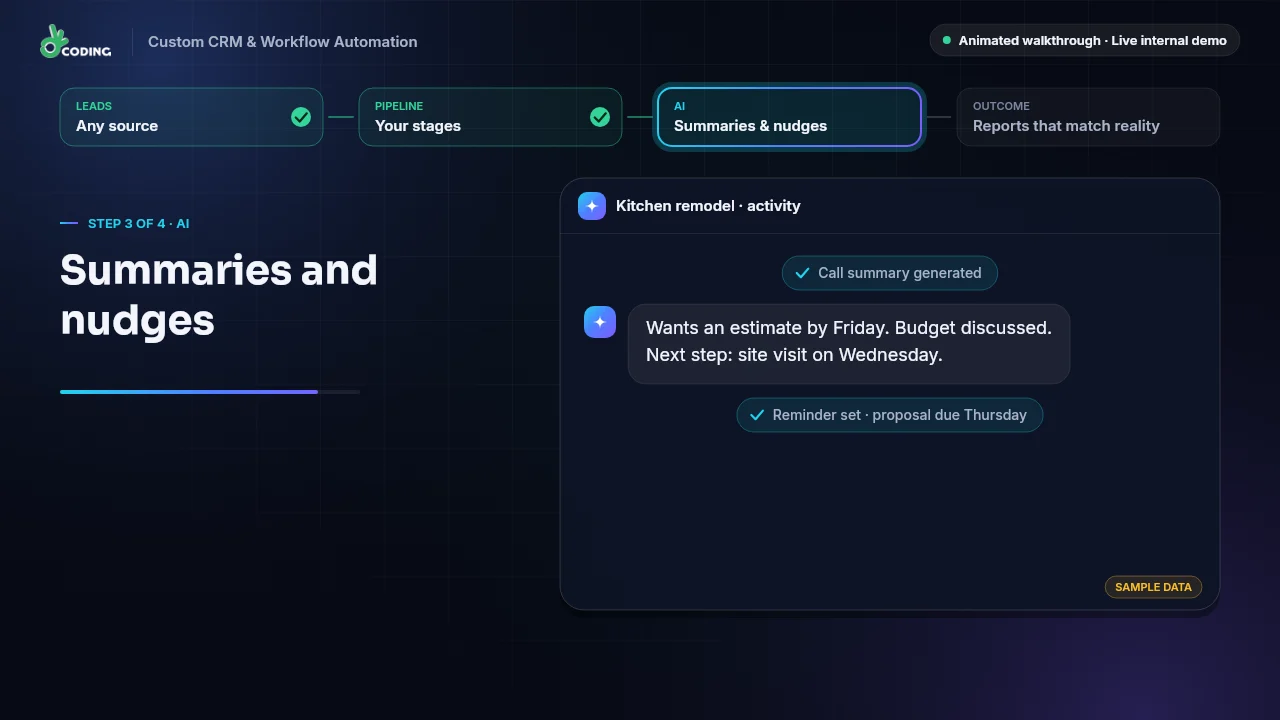
Our run operations on rails page explains how we think about which processes deserve that sturdier setup, and the custom CRM workflows demo shows what a multi-step flow looks like in practice.
Frequently asked questions
Is n8n free?
The self-hosted Community Edition has no subscription fee, but you pay for the server and for the time to maintain it. n8n's cloud plans are paid subscriptions, with free trials listed on its pricing page.
Can I move my Zaps to n8n later?
There is no one-click migration. Each workflow has to be rebuilt, which is a good moment to simplify it.
Which is better for AI features?
Both offer AI steps and assistants. The bigger question is where the AI sits in your process and what happens when it is unsure. Read what is AI automation for a plain-English overview before choosing a tool for it.
Not sure which tool fits your workflows? Book a short call and we will look at your processes with you.
This article describes approaches and how our demos behave. It does not report measured customer outcomes unless it says so with methodology and permission.