
Walk into most independent repair shops at 10 a.m. and you will see the problem. Two technicians are under cars, the service writer is explaining an estimate to a customer at the counter, and the phone is ringing. Nobody can pick up. The caller hears voicemail, hangs up, and calls the shop down the street.
Shop owners know this happens. What they usually underestimate is how often. A ringing phone during a busy hour is not an exception; it is the normal state of a shop that is doing well. The busier you are, the more calls you miss, and the more work you hand to competitors at exactly the moment you could afford to grow.
Why voicemail does not work for repair shops
A driver with a grinding noise is not going to leave a message and wait. They are already worried, already comparing, and already holding a phone. The first shop that answers with something useful wins, even if it is not the closest or the cheapest.
Voicemail fails for three reasons that have nothing to do with how good your shop is:
- Nobody wants to describe a car problem to a machine. They want to be asked questions.
- Callers assume a shop that does not answer is too busy to take them. Sometimes that is true, but they do not know that you had a slot at 2 p.m.
- Returning the call later means you are now the one interrupting. Half the time you reach voicemail yourself.
Hiring a receptionist solves this during business hours, at a cost many independent shops cannot justify year-round. And it does nothing for the calls that come in at 7 p.m. when someone finally has time to deal with their car.
What "answering every call" actually requires
The goal is not to replace the conversation your service writer has with a customer. It is to make sure that conversation happens, and that the customer is already on your schedule when it does. In practice that means four things:
- Pick up every time, whether it is 10 a.m. on a Monday or 9 p.m. on a Sunday.
- Ask the questions your techs would ask: what car, what symptom, when it started, whether it is drivable.
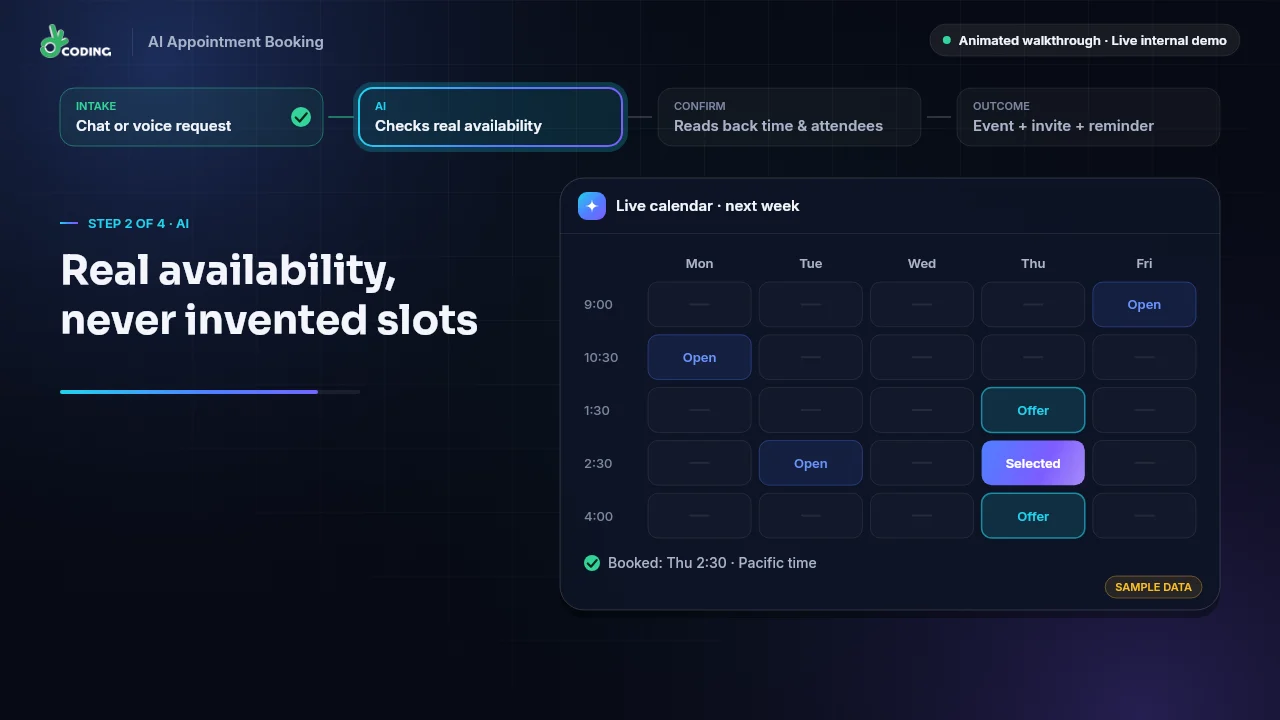
- Offer a real drop-off time from the shop's actual calendar, not "someone will call you back."
- Confirm by text, so the customer has the address, the time and a way to reschedule.
None of that requires diagnosing the car or quoting the repair. Those stay with your people. What gets automated is the intake: the part that costs you jobs when it does not happen.
How an AI receptionist handles a repair call
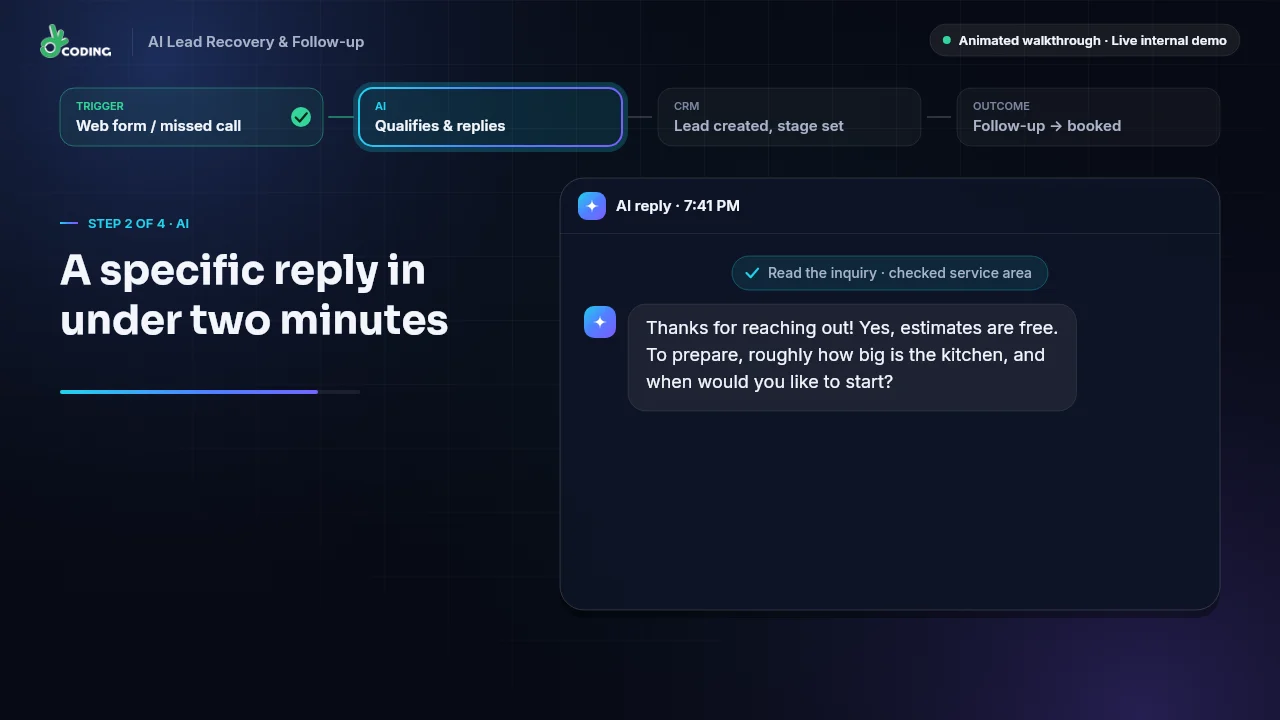
This is what the flow looks like in the system we built for shops, and you can watch it in our AI appointment booking demo:
A driver calls or messages: "There's a grinding noise when I brake." The assistant asks three triage questions: which car, how long it has been happening, and whether the noise is constant or only when braking. It checks the shop's availability and offers two drop-off times. The driver picks Tuesday at 8 a.m. The assistant confirms by text, adds the appointment to the shop calendar with the triage notes attached, and tells the driver what to expect at drop-off.
When your service writer opens the schedule Tuesday morning, the car, the symptom and the customer's phone number are already there. The first human conversation starts from "let's take a look at those brakes," not "so what seems to be the problem?"
For calls that are not appointments — a parts question, a warranty issue, someone asking whether their car is ready — the assistant takes the details and hands them to the right person, with the context already written down.
What it deliberately does not do
- It does not diagnose. "Grinding noise" is recorded as a symptom, never as "you need new rotors."
- It does not quote prices. If asked, it says the technician will look at the car first and gives the shop's inspection policy.
- It does not pretend to be a person. It says it is the shop's assistant and offers a callback from a human whenever the caller wants one.
Those limits are what make shop owners comfortable turning it on. The assistant books the visit; your team keeps every decision that touches the car or the invoice.
The follow-ups most shops never get to
Answering the call is the first half. The second half is everything that depends on someone remembering:
- Estimate approvals. An estimate sent by text at 11 a.m. and not approved by 2 p.m. gets a gentle nudge. Approved work starts sooner; the bay is not blocked waiting.
- "Is my car ready?" Status updates at each stage (in diagnosis, waiting on parts, ready for pickup) remove most of those calls entirely.
- Reviews. A request sent the day after pickup, to customers who did not have a problem, is how a shop builds the review count that brings in the next caller.
- Maintenance reminders. The oil change in 5,000 miles is a customer you already have.
Each of these is a small task. Together they are the difference between a shop that runs on the owner's memory and one that runs on a system.
What it takes to set this up
Less than most owners expect, because the pieces already exist:
- Your existing phone number stays. Calls route to the assistant only when nobody picks up, or always after hours — your choice.
- Your calendar or shop management software is the source of truth for availability. The assistant reads it; it does not keep its own.
- Texts go out from a number customers recognise, with your shop name.
- You decide the script: which questions to ask, what to say about pricing, when to escalate to a person.
We build this as a custom setup around how your shop already works, not as a one-size-fits-all app. If you want to see it handle a real call before you decide anything, the demo shows the full flow, and you can book a call with a specialist who will tell you honestly whether it fits a shop your size.
This article describes approaches and how our demos behave. It does not report measured customer outcomes unless it says so with methodology and permission.