
When a car starts making a strange noise in Glendale or Burbank, the owner searches "auto repair near me," "brake shop Glendale" or "check engine light Burbank." The three shops in Google's map pack get most of the calls. Local SEO for an auto repair shop is the work of earning one of those spots and turning the view into a booked appointment.
It takes an accurate Google Business Profile, a website that answers drivers' questions, steady reviews, and someone who picks up the call. Here's a practical checklist.
How Google ranks local shops
Google's help page "Tips to improve your local ranking on Google" names three main factors:
- Relevance: how well your profile matches the search. A shop listed only as "Auto repair shop" with no services listed is a weaker match for "transmission repair."
- Distance: how far you are from the searcher, or from the location in the search. You can't change where your shop is, so the other two factors matter more.
- Prominence: how well known you are, based partly on information from across the web, links and reviews.
The same page says there's no way to pay for a better local ranking. Ads are separate. Everything below improves relevance and prominence.
Step 1: Get your Google Business Profile right
Your profile often matters more than your homepage. Check these, in order:
- Verified and claimed by the owner, with the login stored somewhere the business controls, not on a former employee's phone.
- Business name exactly as it appears on your sign. Google's guidelines for representing your business don't allow adding keywords like "Best Brakes Glendale" to the name, and doing it can get a profile suspended.
- Primary category set to the closest match (for example "Auto repair shop"), plus secondary categories that are true, such as "Brake shop," "Oil change service" or "Auto body shop."
- Services listed one by one: brakes, diagnostics, smog check if you're licensed for it, A/C, transmission and so on.
- Hours that match reality, including holiday hours.
- Photos of the real shop, bays, team and signage, so people recognize you from the street.
If you're a mobile mechanic without a customer-facing location, set it up as a service-area business and list the cities you cover instead of showing a home address.
Step 2: Build service pages that answer real questions
Drivers search by problem and by city. A single "Services" page with a bullet list can't match "check engine light diagnosis Burbank" as well as a dedicated page can. For your main services, create a page that covers:
- The symptoms people notice ("grinding when braking," "car shakes at highway speed").
- What the diagnosis involves and roughly how long it takes.
- Which makes you work on, and anything you don't do.
- Your address, the areas you serve (Glendale, Burbank, Atwater Village, Eagle Rock or wherever applies) and a clear way to book.
Write for people first, not for keyword counts. If your site is slow on a phone, fix that first. Our checklist of signs your website is costing you leads is a good starting point, and our website service covers rebuilds.
Step 3: Keep your name, address and phone consistent
Your shop name, address and phone number should match on your website, your Google profile, Yelp, Apple Maps, Bing and any industry directories. Search for any old phone number once, then correct or claim the stale listings you find.
On your website, adding LocalBusiness structured data (schema.org has an AutoRepair type) helps search engines read your hours, address and phone reliably.
Step 4: Earn reviews steadily
Prominence leans heavily on reviews, and drivers read them closely. Ask every customer after pickup, use a direct review link, and never offer discounts for reviews. Google's policy forbids it. We cover the timing, wording and rules in how to get more Google reviews without asking awkwardly.
Reply to reviews, especially critical ones. A calm reply shows the next reader how you treat people.
Step 5: Make sure the search turns into a booking
Ranking is wasted if the call goes to voicemail on a busy afternoon. Look at:
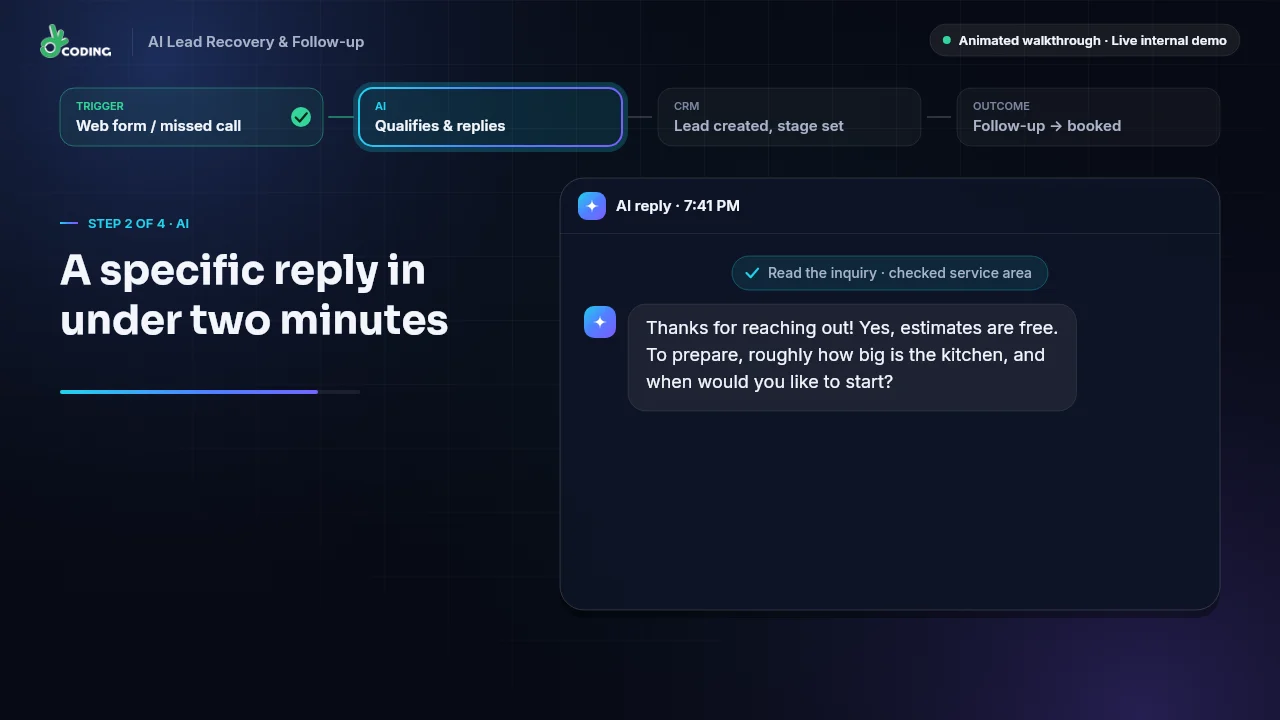
- Missed calls: a text-back that offers a booking link when nobody can answer. We wrote about this in how auto repair shops stop losing jobs to missed calls.
- Web forms: test that form submissions actually reach someone. Here's a 10-minute form check.
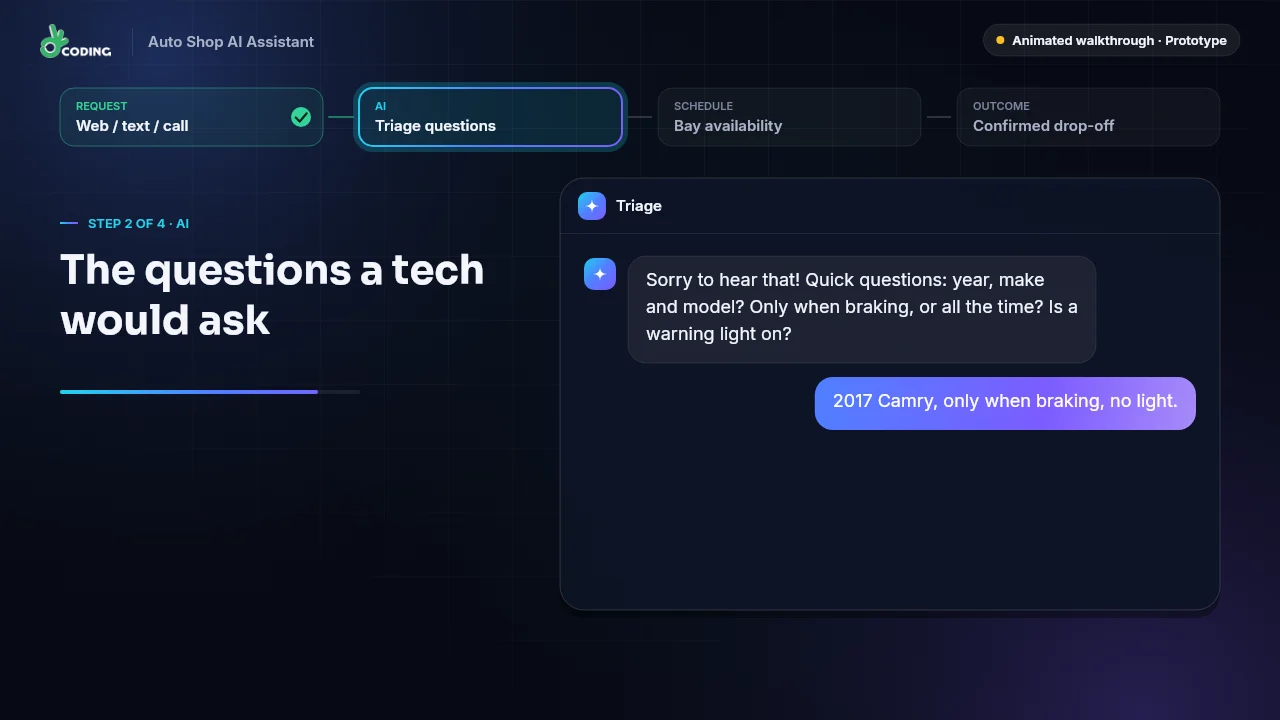
- After-hours questions: an assistant that can answer "are you open Saturday?" and take booking requests. See our auto shop assistant demo and our auto repair page.
What to track each month
Your Business Profile Performance view shows searches, calls, direction requests and website clicks. Track those along with the leads you actually booked. If profile views go up but calls don't, the problem is your profile content or your reviews. If calls go up but bookings don't, the problem is how calls get answered.
Frequently asked questions
How long does local SEO take for an auto repair shop?
Profile fixes such as categories, hours and services can show up quickly once Google processes them. Reviews and service pages build up over months. Be wary of anyone promising a guaranteed ranking. Google says rankings can't be bought.
Should I put "Glendale" in my business name on Google?
Only if it's part of your real business name on your sign and paperwork. Google's guidelines don't allow adding location or service keywords to the name, and doing it risks suspension.
Do I need a separate page for each city?
Not necessarily. A strong page for each main service that names the areas you actually serve usually works better than many near-identical city pages.
Want help with the website and the follow-up side, so local searches turn into booked cars? Book a call and we'll look at your setup together.
This article describes approaches and how our demos behave. It does not report measured customer outcomes unless it says so with methodology and permission.