
Independent auto repair and body shops in Glendale and Burbank are the first industry we are focusing on. Not because it is the only industry we serve, but because the intake problem is sharp, easy to see, and costly when it goes wrong.
The front-desk squeeze
The person answering the phone is also checking in a customer, printing an estimate and finding a key. Online requests wait. Calls go to voicemail. Nobody is doing anything wrong; there are simply more conversations than hands.
The result is familiar to most shop owners: a customer fills in the website form on Sunday night, nobody sees it until Monday afternoon, and by then they've booked with another shop down the street.
Where requests get lost
In a typical shop, new work arrives through several channels at once:
- Phone calls, often while the service writer is with another customer. We cover this in detail in how auto repair shops stop losing jobs to missed calls.
- Website forms and quote requests, which land in an email inbox nobody watches closely. Our ten-minute website form check shows how to test yours.
- Text messages and social media, sent to whoever's personal phone is on the website or profile.
- Google Business Profile messages and calls, which are easy to forget about entirely.
Each channel on its own looks manageable. Together, they mean nobody has the full picture.
What we are building for shops
Our Auto Shop AI Assistant is a prototype, and it is labeled exactly that. It is built around three jobs:
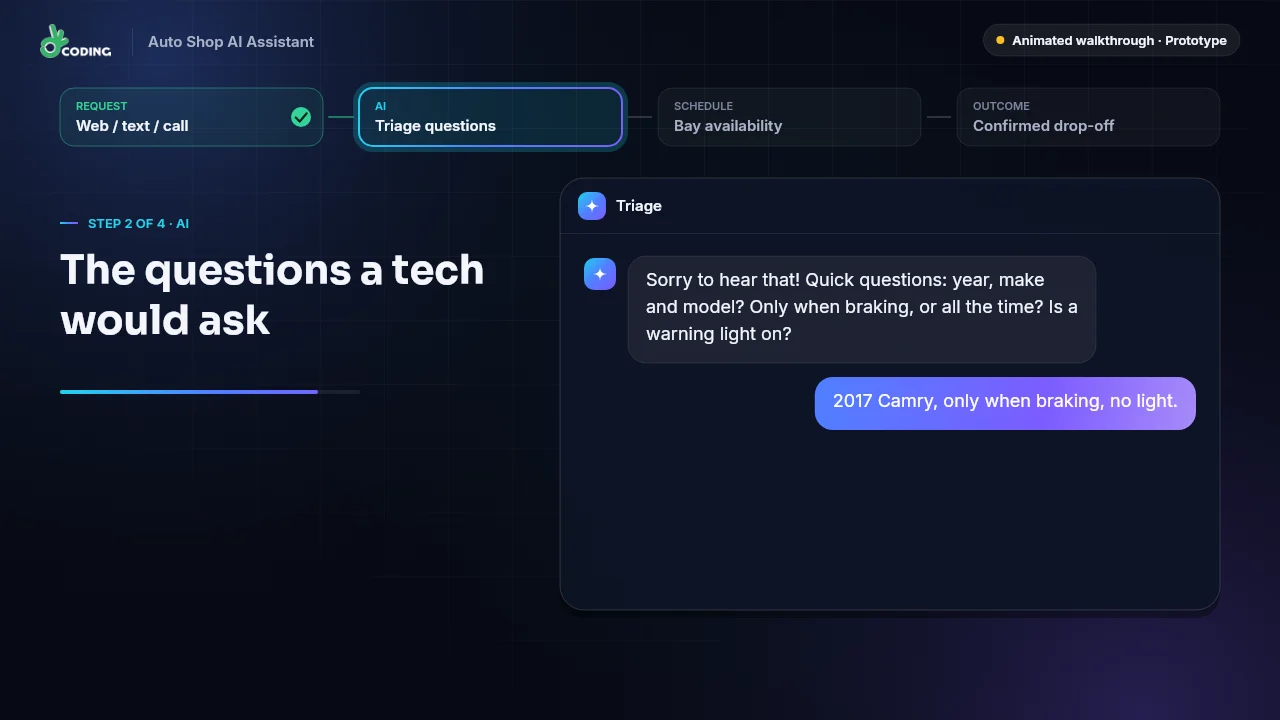
- Intake that collects the vehicle, the issue and how urgent it is, with three or four smart questions instead of a long form.
- Drop-off scheduling against real bay availability, so customers only see times the shop can actually handle.
- Confirmations and reminders by text, with an easy opt-out.
Behind that, every request becomes one record the whole team can see, with an alert to whoever is on duty. Nothing depends on one person's inbox or phone.
What it doesn't do
The assistant doesn't diagnose cars or give prices for repairs. Estimates depend on inspecting the vehicle, and a wrong number is expensive for everyone. When a customer asks for a price, the assistant collects the details and hands the request to a person.
How we will report results
We will publish results only once we have measured them over a defined period with the shops' permission. Until then, we don't quote numbers. If a vendor promises you a specific increase in booked jobs before seeing how your shop works, ask how they measured it.
Frequently asked questions
Does this replace shop management software?
No. Most shops already use software for repair orders and invoices. The assistant handles the conversation before the car arrives and passes the details on. Where your software allows it, the two can be connected.
Is this only for shops in Glendale and Burbank?
No. That's where we are starting, so we know the local market best. The same setup works for independent shops anywhere in the US.
What does a shop need to get started?
A clear idea of how drop-offs are scheduled today, access to the calendar or system you use, and one person who can make decisions. See AI automation for small businesses or book a call with a specialist.
This article describes approaches and how our demos behave. It does not report measured customer outcomes unless it says so with methodology and permission.