
If your business sends text messages from a regular 10-digit phone number through software (appointment reminders, missed-call text-back, quote follow-ups), you have probably run into the phrase "A2P 10DLC." Maybe your texting tool asked you to register. Maybe your messages started failing and nobody could tell you why. This guide explains what A2P 10DLC registration is, who needs it, what it costs at one major provider, and how to get approved the first time.
This is general information, not legal advice. Messaging rules change, so check your provider's current documentation before you register.
What A2P 10DLC actually means
A2P stands for application-to-person: a message sent by software rather than typed by a person on a phone. 10DLC means "10-digit long code," the ordinary local-style number your customers already recognize. Twilio's documentation describes A2P 10DLC as "the standard that United States telecom carriers have put in place" for this kind of traffic.
In plain terms, US carriers want to know who is sending business texts, why, and how customers agreed to receive them. Registration is how you tell them. Toll-free numbers and short codes have their own separate verification processes and are not part of the 10DLC system.
Who has to register
According to Twilio's A2P 10DLC documentation, anyone sending SMS or MMS from an application over a 10DLC number to US recipients must register, and that "includes individuals and hobbyists." If your CRM, booking system or missed-call text-back sends messages from a local number, it applies to you, even if you only send a few dozen texts a week.
The practical consequences of skipping it are real. Twilio says unregistered senders pay extra carrier fees, and that registration "results in lower message filtering." Bandwidth, another carrier-grade provider, warns in its support center that unregistered traffic is at higher risk of being blocked, and that once it is blocked, "the only path to getting the traffic unblocked is to register that traffic."
The two parts: brand and campaign
Registration has two pieces.
The brand is who you are: your legal business name, tax ID, address and website. Carriers use it to confirm you are a real business.
The campaign is what you send: the use case (for example, customer care or account notifications), sample messages, how customers opt in, and how they opt out or ask for help.
After the campaign is approved, your phone numbers are linked to it and your messages travel on the registered route. Twilio's vetting FAQ says registration currently takes up to 5 business days for standard use cases, and you can only send on that route once the campaign is fully approved.
Choosing a brand type
Twilio offers three brand types, and picking the wrong one is a common source of delays:
- Sole Proprietor: for senders without a tax ID such as an EIN. One campaign per brand and a low daily limit.
- Low-Volume Standard: requires a tax ID. Up to five campaigns, suited to businesses sending a few thousand messages a day or fewer.
- Standard: requires a tax ID and includes secondary vetting. Daily limits depend on your Trust Score.
Most small service businesses with an EIN fit Low-Volume Standard. If you expect your volume to grow quickly, ask your provider whether upgrading later is simple.
What it costs (one provider's current numbers)
Fees vary by provider and change over time. As an example, Twilio's support article on 10DLC fees lists, as of November 2026:
- A one-time brand registration fee of $4.50 for Sole Proprietor and Low-Volume Standard brands, or $46 for a Standard brand including secondary vetting.
- A one-time $15 campaign vetting fee, which is non-refundable. A rejected campaign can cost more when you resubmit.
- A monthly campaign fee from $1.50 to $10 depending on the use case, plus per-message carrier fees on top of normal messaging rates.
If you use a texting feature inside another platform, that platform may bundle or mark up these fees. Ask for the breakdown in writing.
How to get approved the first time
Most rejections come from mismatches and vague answers. Before you submit:
- Make your details match exactly. The legal name and EIN must match IRS records, and the website should clearly show the same business.
- Publish a privacy policy that says you do not share or sell mobile numbers for marketing.
- Show the opt-in. If customers agree on a website form, add a consent line and an unchecked checkbox near the phone field, and describe that flow in the campaign.
- Write realistic sample messages. Include your business name and opt-out language, for example: "Reply STOP to opt out."
- Handle STOP and HELP. Make sure your system honors opt-outs automatically and answers HELP with your contact details.
- Avoid public link shorteners in messages; Bandwidth lists them among practices to avoid.
Where registration fits in your follow-up
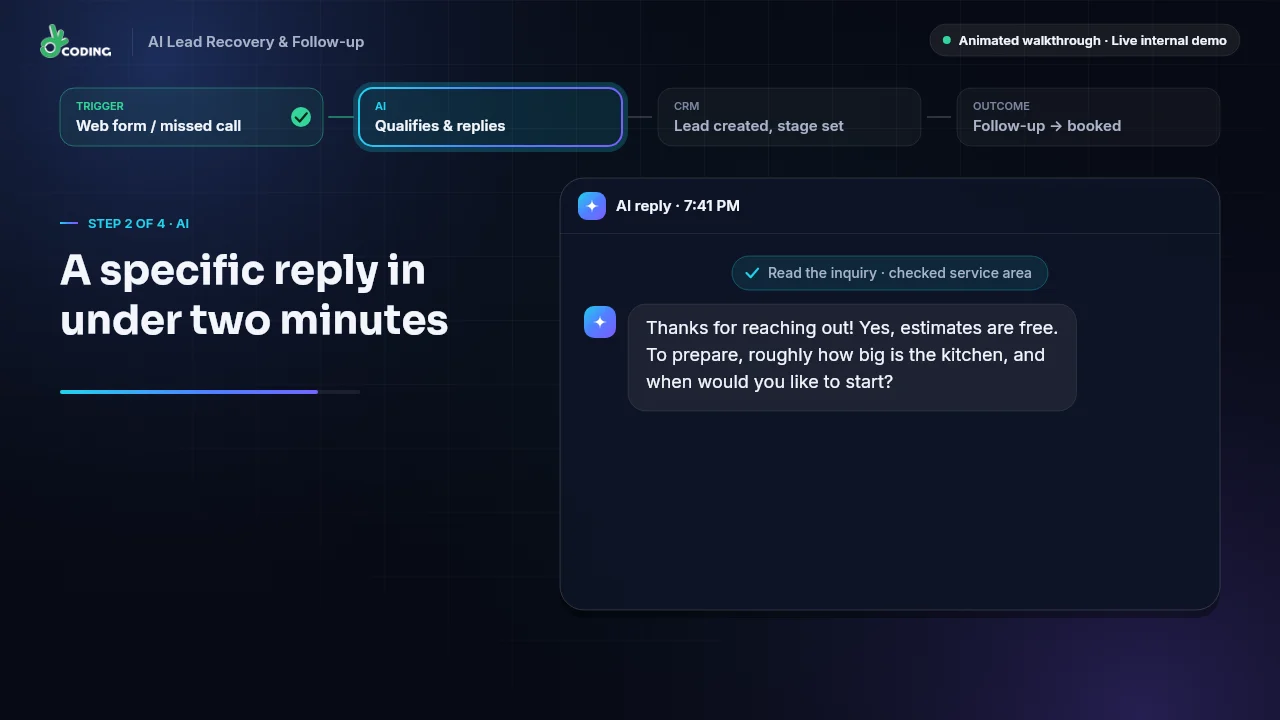
Registration is a one-time setup step, but it decides whether your fast follow-up reaches anyone. A five-minute reply is worthless if the carrier filters it. When we build AI automation or a lead-recovery flow that texts customers, registration, opt-in wording and STOP handling are part of the build, not an afterthought. You can see how a text follow-up behaves in our AI lead recovery demo.
Frequently asked questions
Do I need A2P 10DLC if I text customers from my own cell phone?
Messages you type yourself on a personal phone are person-to-person traffic, not A2P. Registration applies when software sends texts over a 10-digit number, which includes most CRMs, booking tools and auto-reply systems.
How long does A2P 10DLC registration take?
Twilio currently says up to 5 business days for standard use cases, and suggests contacting support if vetting is still in progress after 10 days. Plan for rejections: fixing and resubmitting adds time.
Is 10DLC registration the same as TCPA compliance?
No. Registration tells carriers who you are and how you collect consent. The TCPA is a federal law about calls and texts to consumers. You need to think about both, and a lawyer is the right person for TCPA questions.
Need texting set up properly inside your follow-up system? Book a call and we will walk through it with you.
This article describes approaches and how our demos behave. It does not report measured customer outcomes unless it says so with methodology and permission.